
A concealed operator hides the drive unit below the gate hinge line, but the installation is not hidden from engineering problems: alignment, drainage, gate weight, safety and service access determine whether it works reliably. By the end, you will be able to trace the motor’s movement, check whether your existing gate can accept one, and identify the Nagpur-specific details that deserve attention before concrete is poured.
Key takeaways
- Measure leaf width, weight, hinge position, and opening angle before choosing a motor.
- Use separate motors and calibrated limits to coordinate two swing-gate leaves.
- Protect underground operators from Nagpur’s rainwater, dust, corrosion, and poor drainage.
- Choose concealment for appearance and security, not when excavation or maintenance access is difficult.
What sits inside a concealed swing-gate system
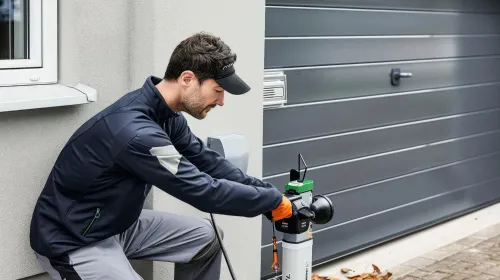
A conceal swing gate motor hides the operator below the gate rather than leaving a motor body on the post. In a motorized swing gate, electrical power reaches the control board and motor; gears reduce speed and increase torque, then a worm shaft turns a drive lever or linkage.
That linkage moves the lower hinge area, making the gate leaf rotate around its hinges. The underground operator normally sits in a metal or polymer foundation box below the hinge line. An in-frame actuator instead fits inside a gate leaf or frame cavity.
| Option | Where it sits | How it moves the gate |
|---|---|---|
| Above-ground articulated-arm operator | On the post or pillar | An exposed arm drives the leaf |
| Underground operator | In a foundation box below the hinge line | A lever connects to the lower hinge area |
| Concealed in-frame actuator | Inside the leaf or frame cavity | An internal actuator drives the hinge mechanism |
A concealed swing gate motor is not merely a smaller visible swing gate motor. The box, hinge axis, drive lever and gate must align as one system; poor setting-out creates friction, noise, stalling and gearbox wear.
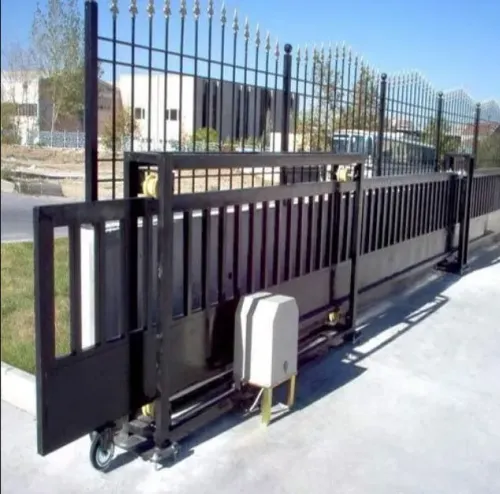
A sliding gate motor turns a pinion against a toothed rack along a track. A folding gate motor coordinates several hinged panels. A hydraulic operator uses pressurised fluid, while a visible linear actuator pushes the gate from the post.
The measurements that decide whether the motor will work
Measure the gate before choosing a swing gate motor; leaf size alone cannot predict performance.
- Record each leaf’s width and weight separately.
- Measure the required opening angle, gate-bottom clearance, pillar depth, hinge height and available cavity depth.
- Check hinge alignment, sag, bearing condition and whether the ground slopes through the swing path.
- Estimate wind torque from the leaf’s exposed area and infill.
A broad solid leaf can impose far more wind load than an open-bar leaf of the same mass. That extra torque can cause stalling or overheating even when the manufacturer’s maximum leaf width appears suitable.
| Existing gate | New frame |
|---|---|
| Retrofit may need reinforced hinges, corrected sag, a lower drive connection, an access panel and a concealed conduit route. | Coordinate the foundation box, hinge axis and gate frame before concrete is placed. |
| Measure the actual gate and correct hardware defects before selecting the operator. | Set the cavity depth, drain, conduit bends, hinge height and bottom clearance together. |
Specify a removable cover that finishes level with the paving but is never buried or blocked by tiles. Poor alignment between the hinge axis, box, lever and leaf creates friction, noise, stalling and premature gearbox wear.
Select duty from actual traffic: compare cycles per hour, cycles per day or percentage duty cycle with arrivals, peak periods and cooling time. Do not rely only on the stated maximum leaf width; a residential rating can fail at an apartment, factory or shared parking entrance.
How two leaves, limits and safety controls are coordinated
The control board coordinates both leaves as one system. During opening, it may start the overlap leaf first; during closing, it may close the other leaf first so the meeting stile reaches the centre stop correctly. An intentional delay prevents collision and protects centre-edge hardware.
Travel stops come from mechanical opening and closing stops, adjustable limit switches, an encoder, or a combination. The operator must not be expected to stop accurately against an arbitrary wall or an unrestrained leaf. Controlled low-speed travel near each end reduces impact and gearbox stress.
A safe automatic swing gate needs more than motor stopping force. Specify:
- Photocells across the vehicle opening, plus protection at closing edges and hinge-side pinch zones; roadway photocells alone leave shear points unprotected.
- A warning lamp that shows movement before and during operation.
- A manual release usable from the secured side when mains power, the control board, or the motor fails, without requiring passage through the closed gate.
- A risk assessment to EN 12453 covering leaves, hinges, posts, stops, controls and surroundings, not merely the motor datasheet.
- Separated low-voltage safety wiring and mains wiring, outdoor-rated cable, sealed glands, protective earthing where applicable, and correctly selected overcurrent and residual-current protection.
Long cable runs can cause voltage drop, producing intermittent faults when the motor starts. A motorized swing gate needs wiring, sequencing and safeguards designed as carefully as its actuator.
Why Nagpur installation conditions matter more underground
The foundation box is the main reliability risk for a concealed operator in Nagpur. Monsoon water must leave through a real drain connected to a soakaway or storm-water system; a small hole discharging into compacted soil is not equivalent drainage.
Silt and standing water lead to corrosion, damaged terminals, seized bearings, failed limit switches and gearbox contamination.
For a motorized swing gate for conceal motor in Nagpur, select the conceal swing gate motor around dust, intense summer heat, cable-gland sealing, corrosion protection and uneven paving. An IP rating describes resistance under specified test conditions; it does not authorise a flooded pit.
The installer must set these items together before concrete and paving:
- Foundation depth, hinge height and gate-bottom clearance
- Finished paving level and removable cover
- Conduit bends and cable-gland positions
- Drainage route to the soakaway or storm-water system
- Cover fasteners and service access
Raise paving over the cover or block its fasteners and routine servicing becomes demolition. A level, removable cover is part of the installation, not a finishing detail.
The concealed operator still depends on ordinary gate hardware. Inspect hinges, bearings, centre locks, stops, photocells, release mechanisms, cover seals and drainage. Repeated motor trips may indicate a sagging leaf, seized hinge, mis-set stop or waterlogged box rather than inadequate motor power.
Summer dust and uneven paving then amplify friction, while poor sealing lets moisture reach terminals and controls.
When concealment is worth choosing—and when it is not
Choose a conceal swing gate motor only if you can service it without breaking paving. The gate needs cavity or foundation-box space, an accurately set hinge axis, proper drainage, an accessible removable cover, and a duty rating that matches traffic.
| Option | What you gain | What it demands |
|---|---|---|
| Visible operator | Easier inspection and quicker access | Exposed hardware and less discreet appearance |
| Underground operator | Cleaner gate and post lines | More civil work, drainage, precise alignment and service access |
Reject concealment when the pit cannot drain, the box cannot be opened, the gate is badly sagging, the pillar or frame cavity is too shallow, paving blocks cover removal, or the leaf’s wind area and opening geometry exceed the operator’s practical load.
A broad solid leaf can overload the drive even when its weight appears acceptable.
For a motorized swing gate for conceal motor in Nagpur, ask the supplier to document:
- Leaf dimensions, weight and infill
- Hinge height, axis alignment and opening angle
- Drain route, box depth and removable-cover access
- Safety devices, manual release and cable protection
- Duty rating against cycles per hour and daily traffic
Nagpur Automation (08048400505) can use those site facts to recommend and install an appropriate automatic swing gate, rather than treating concealment as a substitute for sound hinges, stops, drainage and gate construction.
Related products
 | MOTORIZED SWING GATE AUTOMATIC CONCEAL SWING GATE MOTOR AUTOMATIC CONCEAL SWING GATE MOTOR View product → |
 | Automatic Motorized Swing Gate Our company has emerged as one of the top most positions in the industry for offering a wide range of Automatic Motorized Swing Gate. View product → |
Frequently asked questions
What sits inside a concealed swing-gate system?
The system places the operator below the gate, where a motor, reduction gears, worm shaft, drive lever or linkage, control board, wiring, and safety devices work together.
Which measurements determine whether a swing-gate motor will work?
Check each leaf’s width and weight, hinge condition, opening angle, available underground depth, clearance, wind exposure, and the gate’s balance before selecting the operator.
How are two swing-gate leaves coordinated?
Each leaf uses its own operator, while the control board manages opening order, closing order, travel limits, timing, photocells, and obstruction response.
Why do Nagpur installation conditions matter for concealed motors?
Underground operators need effective drainage, a sealed installation box, corrosion protection, and accessible maintenance points because monsoon water, dust, and soil conditions affect reliability.
When is a concealed swing-gate motor the wrong choice?
Avoid it when excavation is impractical, drainage cannot be controlled, the gate is badly unbalanced, or future maintenance access would be difficult.
Related products
 | We are highly acknowledged organization engaged in presenting remarkable range of Automatic Swing Gate. View product → |
 | We are offering a wide range of Swing Gate Automation. an aesthetic match for any architectural style. View product → |
 | MOTORIZED SWING GATE MOTORIZED SWING FOLDING GATE View product → |
Keywords